Catering Response-Time Report 2026: How Fast You Have to Reply to Win the Booking
How fast must caterers reply to win a booking? A sourced 2026 report on response time and lead conversion — the 42-hour average and the 5-minute rule.
Most catering inquiries are won or lost in the first hour — long before the food, the price, or the proposal ever matter. A client texts three caterers on a Tuesday night; whoever answers first, clearly and fast, usually gets the booking.
There is no published study that measures catering inquiry-to-booking timing directly. So this report does the next best thing: it combines the strongest cross-industry research on response time and lead conversion with event-industry data on how clients actually shop for vendors. Every figure below is sourced and dated — and where a popular stat turned out to be marketing folklore, we left it out (and said so at the end).
The short version: speed is not a nice-to-have. It is the single biggest lever most caterers are not pulling.
The number that should scare you: 42 hours
When Harvard Business Review audited how fast 2,241 U.S. companies replied to a web inquiry, the average first response took 42 hours. Only 37% replied within an hour, and 23% never responded at all. (HBR, 2011)
That study wasn't about catering — but the behavior is identical to a caterer who sees a 9 p.m. inquiry and answers it the next afternoon between events. The inquiry is still "handled." It's just handled too late to matter.
The same researchers found that companies trying to reach a lead within an hour were nearly 7× more likely to have a meaningful conversation with the decision-maker than those who waited just one hour longer — and 60× more likely than those who waited 24 hours or more. (HBR, 2011)
| If your first reply takes… | What the research shows |
|---|---|
| Under 1 hour | ~7× more likely to qualify the lead vs. waiting one more hour |
| 1–24 hours | Sharp drop-off — you're now competing from behind |
| Over 24 hours | ~60× less likely to connect than a sub-1-hour reply |
| Never (23% of companies) | The inquiry is simply lost |
One caveat we'll repeat throughout: this is 2011 sales-lead data, not catering data. But catering inquiries are sales leads — high-intent, time-sensitive, and almost always sent to more than one vendor.
The 100× rule: why 5 minutes beats 30
The most-cited number in lead response comes from a MIT study (Dr. James Oldroyd) run with InsideSales across 15,000+ leads and 100,000+ call attempts. The finding: you are 100× more likely to connect with a lead if you respond within 5 minutes instead of 30 — and 21× more likely to qualify it. (Lead Response Management Study, 2007)
Read that again. The difference between five minutes and thirty isn't 10% or 50%. Contact rates fall by a factor of one hundred. Most of the decay happens fast — contact success drops more than tenfold inside the first hour.
For a caterer, "five minutes vs. thirty" is the difference between answering a text while you're prepping and answering it once you finally sit down. The window is smaller than it feels.
(Dated honestly: this study is from 2007 and measured phone follow-up to sales leads. The magnitudes are dramatic and often loosely repeated — we're citing the original, not the recycled versions.)
Your clients expect a reply in minutes, not hours
Client expectations have only tightened since those studies. Today:
- 90% of consumers say an immediate response is important when they have a question — and "immediate" now means 10 minutes or less. (HubSpot, 2018)
- 64% of consumers and 80% of business buyers expect companies to respond and interact in real time. (Salesforce, State of the Connected Customer, 2018) In Salesforce's 2023 edition, 81% say they expect faster service as technology improves.
- Texting is where this plays out. Roughly 30% of people check a new text within 60 seconds, and 80% within five minutes. (SimpleTexting, 2024) SMS open rates run near 98% versus about 20% for email. (Gartner)
Translation for caterers: the corporate client texting about a Friday lunch, or the couple messaging at 11 p.m., isn't planning to wait until morning. They're texting two or three of you — and watching their phone.
Catering is a multi-vendor race — and first responders win
Here's why response time matters more in catering than in a one-vendor purchase: clients shop around.
The Knot's Real Weddings Study — the category's benchmark survey, with roughly 9,000+ couples — finds couples hire an average of about 14 wedding pros per wedding, and nearly half keep inquiring with additional vendors specifically to compare costs. (The Knot Real Weddings Study)
So a typical catering inquiry isn't a private conversation — it's an open race against the other caterers already in the client's inbox. And the research in the sections above says the same thing every time: the vendor who responds first and fastest captures a disproportionate share of the conversations, and conversations are what convert.
You don't have to be the cheapest. You have to be first — and good.
What every slow reply actually costs
Put the pieces together and the cost of a slow reply is concrete:
- A late reply doesn't just lower your odds on that booking — it hands the conversation to whichever competitor answered first.
- Catering runs on thin margins. Catering consultants estimate the average caterer nets just 7–8% pretax (versus 3–4% for full-service restaurants). (Catersource) When margins are that thin, a handful of lost bookings a month is the difference between a strong year and a flat one.
- And you can't simply "answer faster" by working more: 86% of caterers report being understaffed (2023 ICA Industry Survey). (ICA, 2023) The hours to reply instantly, 24/7, don't exist on most teams.
That's the trap: the data says reply in minutes, the reality says you physically can't. Something has to answer for you.
State of Catering 2026: the backdrop

A quick benchmarking box for context — all sourced:
- Market size. U.S. catering is a $15.7B industry by the narrow definition (standalone caterers, IBISWorld, 2026) and $60B+ by broader measures that include contract and event catering (Grand View Research).
- Growth and pressure. In the 2023 ICA survey, 68% of caterers grew revenue, but 86% were understaffed and 92% had raised pay. (ICA, 2023)
- No-shows are real. 28% of U.S. diners admit to skipping a reservation in the past year (OpenTable / YouGov, 2021), and deposits cut no-shows by roughly 57% (OpenTable). The catering parallel is the signed-but-unconfirmed event — which is why collecting a deposit at booking matters as much as speed.
- Deposits. Catering deposits commonly run 25–50% of the total, with ~50% widely treated as standard. (Common industry practice, not a surveyed figure.)
The throughline: demand is healthy, teams are stretched, and margins are thin — so the cheapest growth available to most caterers isn't more leads, it's converting more of the leads they already get. Which comes straight back to speed.
The response-time standard to set for your business
A practical standard, drawn from the research above:
- Target a first reply in under 5–10 minutes, every hour of the day. That's the threshold the data keeps pointing to (the MIT 5-minute rule; HubSpot's 10-minute definition of "immediate").
- Answer after hours. A large share of inquiries arrive evenings and weekends — exactly when you're working an event or asleep. A reply that waits until morning is competing from behind.
- Reply with substance, not just "got it." The HBR and MIT findings are about qualifying — having a real conversation. A fast reply that also asks the date, guest count, and budget moves the booking forward.
- Never make a hot lead repeat themselves. Capture the inquiry once and carry the details into the quote.
Most caterers can hit one or two of these by hustling. Hitting all four, consistently, is a systems problem — not a willpower problem.
How Edesia makes instant replies automatic
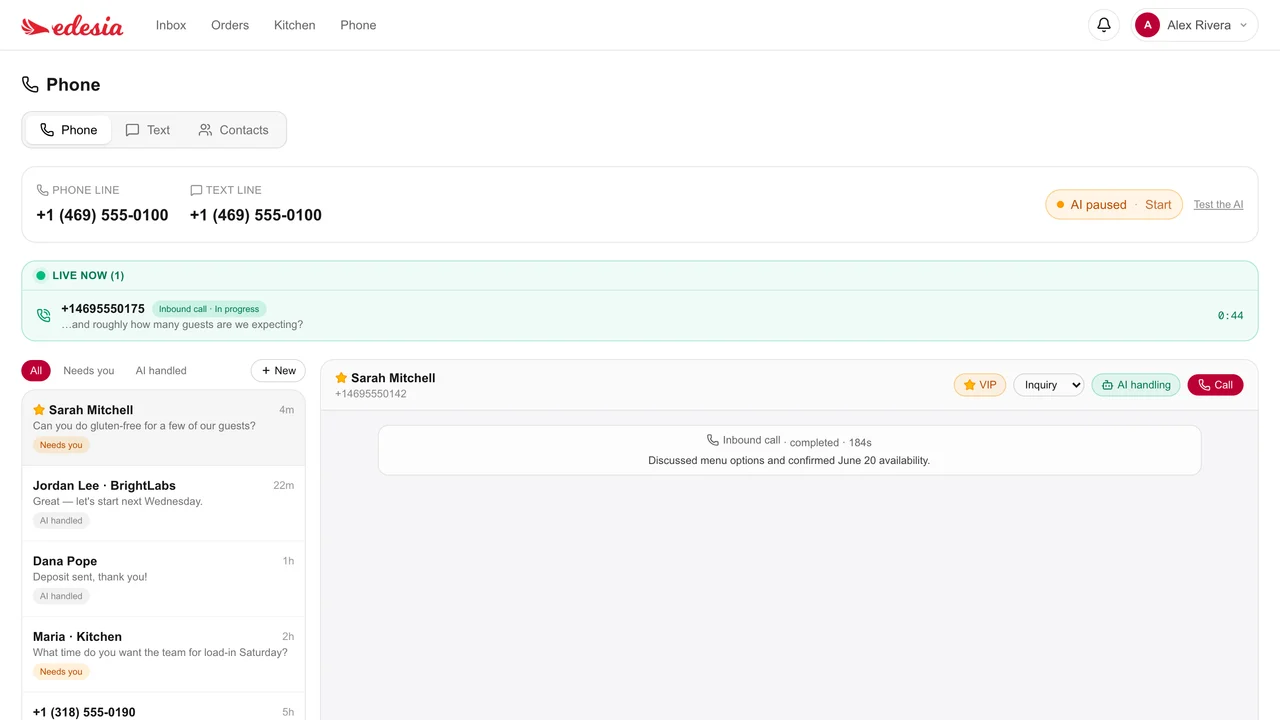
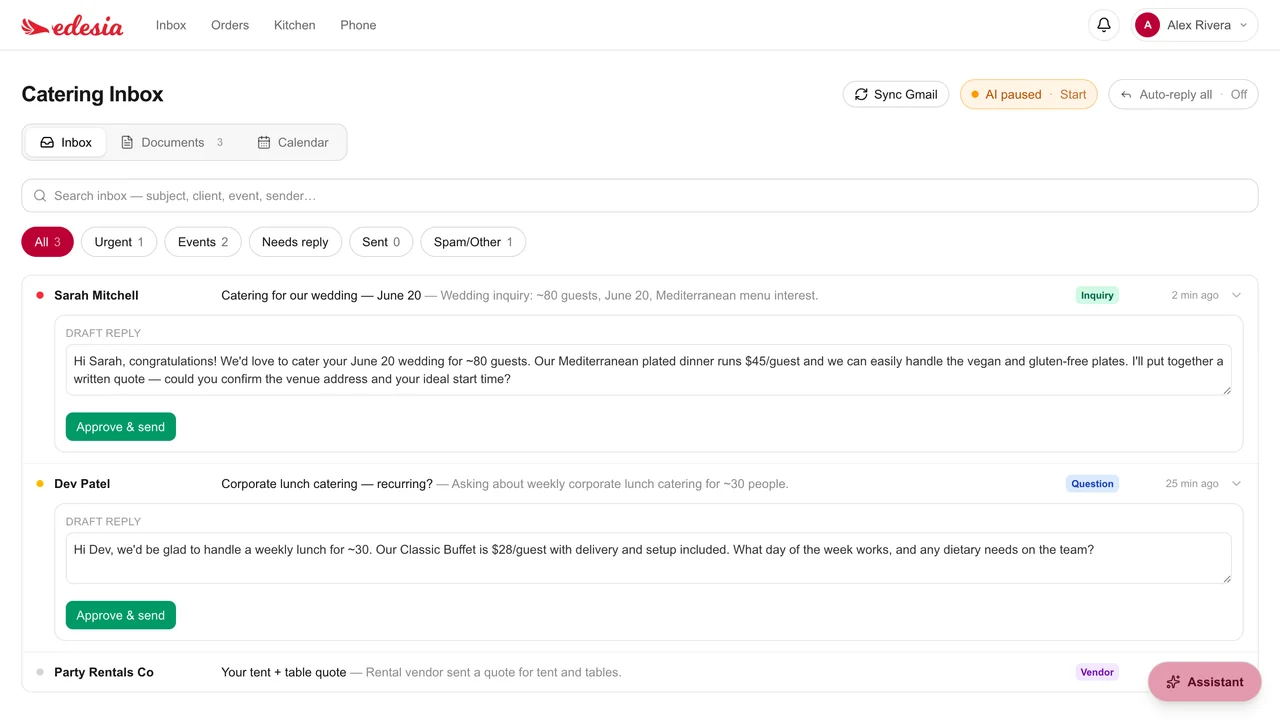
Edesia is an AI catering assistant built for exactly this gap. It answers client calls, texts, and emails instantly, 24/7, in your voice — asking the date, guest count, and menu, sending your price, and holding the date. Your regulars and VIPs get passed straight to you; everything else gets a fast, substantive reply before a competitor wakes up.
It's how the response-time research above becomes operational for a stretched, understaffed catering team: the speed clients expect, without you living on your phone.
Methodology and sources
This report combines cross-industry response-time research with event- and catering-specific data. We deliberately excluded several popular stats — including "78% of customers buy from the first responder," "95% of texts are read within 3 minutes," and various missed-call figures — because they could not be traced to a credible primary source.
Primary sources:
- Oldroyd, McElheran & Elkington. The Short Life of Online Sales Leads. Harvard Business Review, 2011.
- Oldroyd. Lead Response Management Study. MIT / InsideSales, 2007.
- HubSpot Research, 2018.
- Salesforce, State of the Connected Customer, 2018 & 2023.
- Gartner, Tap Into the Marketing Power of SMS.
- SimpleTexting, 2024 SMS Marketing Stats.
- The Knot Worldwide, Real Weddings Study.
- OpenTable / YouGov, 2021.
- Catersource — caterer profit margins.
- IBISWorld & Grand View Research — market size.
- International Caterers Association, 2023 Industry Survey.
Frequently asked questions
How fast should a caterer respond to an inquiry?
As fast as possible — ideally within 5–10 minutes, day or night. Research on lead response finds you're up to 100× more likely to connect with a lead at 5 minutes than at 30 (MIT / InsideSales, 2007), and ~7× more likely to qualify it within the first hour (HBR, 2011). Catering clients also text multiple vendors, so the first good reply usually wins.
Do catering clients really contact multiple vendors?
Yes. The Knot's Real Weddings Study finds couples hire about 14 wedding pros and nearly half keep inquiring with additional vendors to compare costs — so most inquiries are an open race, not a private conversation.
What's the average business response time to an online inquiry?
In Harvard Business Review's audit of 2,241 companies, the average first response was 42 hours, only 37% replied within an hour, and 23% never replied at all. Most caterers can beat that easily — and beating it is worth real bookings.
Is texting better than email for catering inquiries?
For speed, yes. SMS open rates run near 98% versus about 20% for email (Gartner), and about 80% of people read a text within five minutes (SimpleTexting, 2024). Meeting clients on the channel they actually check fast is half the battle.
Why can't caterers just reply faster themselves?
Because 86% of caterers report being understaffed (2023 ICA survey), and inquiries arrive nights and weekends during events. Replying in minutes, 24/7, is a systems problem — which is why automated and AI response tools exist.
Keep more of what your kitchen earns
Edesia helps you track inventory, reduce waste, compare suppliers, and plan purchases. Catering orders and customer replies are included, too.