Freezable Meals for Commercial Kitchens: Batch Freezing Logistics, Sauce Stability, and Take and Bake Margins
Learn how commercial kitchens engineer high margin freezable meals, master blast freezing, prevent sauce separation, and build profitable take and bake programs.
Photo by Richard R on Unsplash.
Commercial kitchens face an inevitable reality each week where prep stations sit idle between peak service rushes while fixed overhead costs like rent, utilities, and base payroll continue to accumulate. Simultaneously, guest demand for chef prepared, high quality meals at home peaks during winter and holiday months. Caterers, commissary kitchens, and independent restaurants are uniquely equipped to bridge this gap through structured freezable meal and take and bake programs.
When engineered with commercial discipline, frozen meal lines generate dependable, recurring cash flow while leveling out kitchen labor. Instead of scrambling through erratic daily prep, production teams can schedule dedicated batch cooking blocks during slow morning hours. The financial returns are compelling, with well planned frozen meal programs routinely delivering gross margins above seventy percent. Achieving those margins, however, requires more than simply packing dinner leftovers into foil pans. Commercial operators must understand starch chemistry, manage thermal cooling curves, prevent cellular freeze damage, and invest in proper barrier packaging to ensure that a thawed meal tastes just as exceptional as food served straight from the line.
Food Science and Emulsion Chemistry: Stabilizing Sauces and Starches
The primary reason frozen meals fail in customer kitchens is emulsion breakdown and starch retrogradation. When traditional sauces made with standard flour roux or cornstarch are frozen, amylose starch molecules align and crystallize, squeezing out trapped water during thawing. This weeping effect, known scientifically as syneresis, turns velvety cream sauces into watery liquids separated from curdled dairy proteins.
To maintain silky sauce textures after freezing and reheating, commercial kitchens must replace native starches with modified food starches, such as cross linked waxy maize or pregelatinized tapioca starch. These ingredients withstand extreme temperature swings, low pH environments, and mechanical shear without breaking down. Dairy selection requires equal precision. Low fat milk and delicate soft cheeses separate rapidly when frozen because ice crystals pierce protein micelle structures. Professional caterers rely on heavy cream with at least thirty six percent butterfat, mascarpone, or cultured creme fraiche, where high fat globules shield moisture droplets and preserve emulsion integrity.
Pasta and grain components demand their own production protocols. Standard cooking times spell disaster for frozen entrees, because starch continues absorbing ambient moisture during freezing, cold storage, and final baking. Pasta intended for frozen casseroles must be par cooked to approximately sixty percent of standard cooking time, chilled instantly in an ice bath to halt carryover cooking, and tossed lightly in neutral oil before sauce assembly. When the guest bakes the dish from a frozen or thawed state, the pasta absorbs excess sauce moisture and finishes cooking to a perfect al dente bite without turning into mush.
Blast Chilling and Ice Crystal Dynamics: Protecting Protein Structure
Freezing speed dictates food quality at a microscopic cellular level. When food is placed directly into a standard walk in freezer, the slow drop in temperature creates large, needle shaped ice crystals. These jagged crystals puncture cellular membranes in animal proteins, poultry, and vegetables. When the customer thaws the product, damaged cell walls lose intracellular fluids, resulting in dry, chewy meat and watery vegetable garnishes.
Commercial operations overcome this physical limitation by utilizing rapid blast chilling and shock freezing. Rapid freezing pulls thermal energy out of hot food so quickly that water molecules solidify into microscopic, rounded crystals that leave cellular structures intact. Proteins retain their natural juices, braised meats maintain fork tender tenderness, and vegetables retain crisp structural bite.
Food safety regulations also mandate strict thermal management. Under standard commercial health codes, cooked food must follow a rigorous two stage cooling curve. Product must drop from 135 degrees Fahrenheit down to 70 degrees within two hours, and from 70 degrees down to 41 degrees or lower within an additional four hours. Once food reaches safe holding temperatures, it moves to the blast freezer to achieve zero degrees Fahrenheit core temperature before final palletizing or carton storage. Commercial operators must log internal core temperatures with calibrated digital probes at each transition stage, keeping durable compliance records that protect both customer health and brand reputation.
Commercial Packaging Systems: Barrier Films and Dual Ovenable Trays
Even the most expertly prepared recipe will deteriorate rapidly in frozen storage if exposed to oxygen and moisture vapor loss. Freezer burn occurs when dry cold air evaporates water molecules from the surface of food, leaving behind leathery, oxidized patches that destroy flavor and nutritional value. Standard cling wrap, basic plastic bags, and unlined cardboard containers offer virtually zero protection across weeks of cold storage.
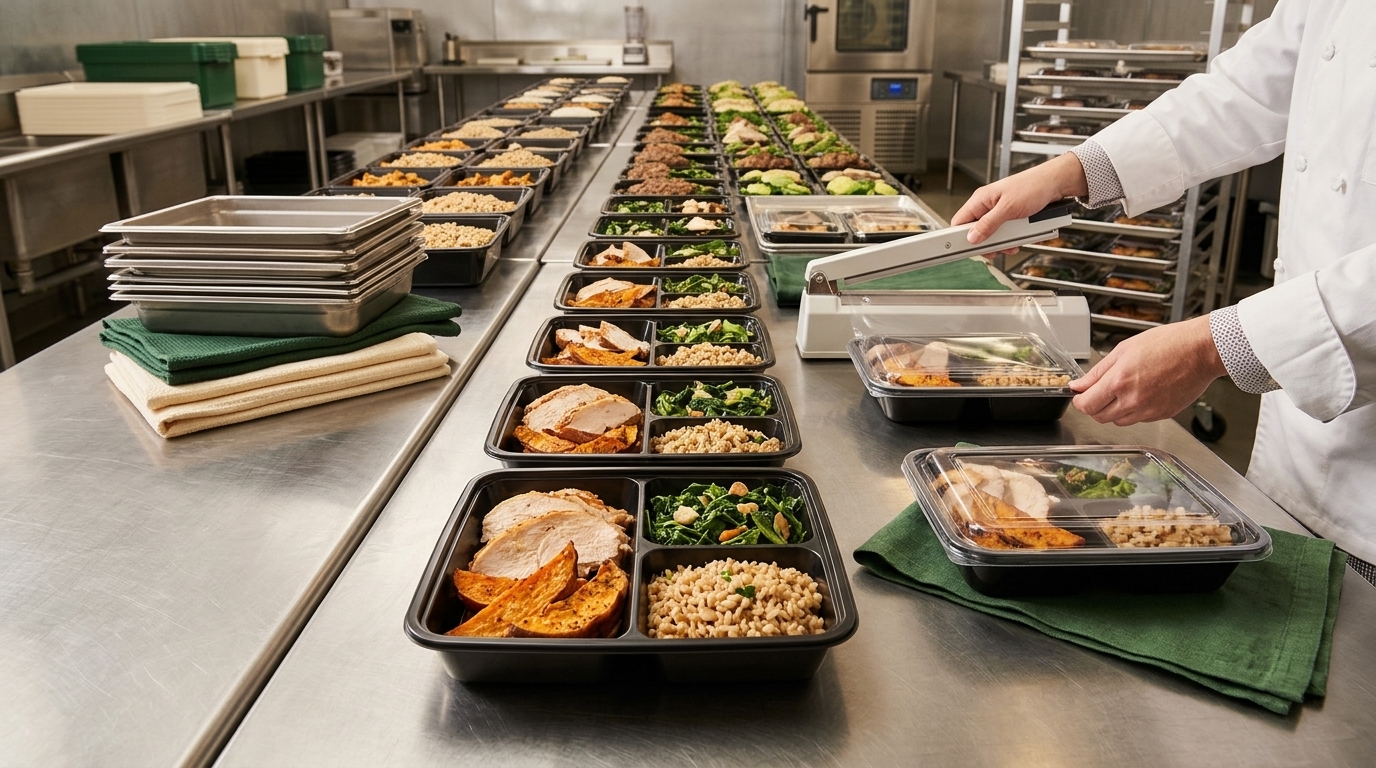
Professional take and bake programs invest in commercial grade packaging solutions built around two primary formats:
-
Crystallized Polyethylene Terephthalate Trays: Known in commercial packaging as CPET trays, these dual ovenable containers tolerate temperature extremes from minus forty degrees Fahrenheit up to four hundred degrees Fahrenheit. Guests can transfer a frozen meal directly from the freezer into a conventional home oven or microwave without transferring food to separate bakeware.
-
Heavy Gauge Aluminum Half Pans: For family size meal packages serving four to eight guests, heavy gauge aluminum half pans with curled rims provide structural rigidity and superior heat conductivity. When paired with laminated cardboard foil lids, they withstand commercial stacking in walk in freezers without crushing.
Headspace elimination is equally critical. Packaging stations should utilize vacuum skin packaging or heat sealed lidding film that creates an airtight seal directly across the surface of the food. Every package must feature clear, water resistant labels detailing product name, net weight, production date, lot tracking code, documented allergen declarations, and foolproof reconstitution instructions specifying target internal baking temperatures of 165 degrees Fahrenheit.
Recipe Costing, Batch Production, and Margin Engineering
A profitable commercial meal prep line requires disciplined recipe costing that accounts for every gram of ingredient, packaging unit, and production labor minute. Operators who price frozen meals simply by marking up raw grocery costs frequently overlook shrink loss during cooking, marinade waste, and lidding supplies.
Begin with raw ingredient yields. Boneless pork shoulder or beef chuck roasted for shredded meat entrees yields roughly seventy percent usable cooked weight after fat rendering and evaporative moisture loss. If raw pork shoulder costs three dollars per pound, the true cooked protein cost is four dollars and twenty nine cents per pound before sauce and seasoning additions. Factoring in packaging supplies, a dual ovenable CPET tray, sealed barrier lidding film, and branded wrap around sleeve add roughly seventy five to ninety cents per unit.
Price frozen entrees to maintain food cost percentages between twenty five and twenty eight percent, yielding seventy two to seventy five percent gross margins. For example, an individual twelve ounce braised beef and root vegetable cottage pie costing three dollars and sixty cents in total ingredients and packaging commands a retail price of thirteen to fourteen dollars. A family size four portion lasagna in a heavy aluminum half pan costing nine dollars and fifty cents to produce commands thirty five to thirty eight dollars.
Commercial kitchens can calculate accurate batch yields and portion margins using Edesia free restaurant food cost calculator at /landing/tools/restaurant-food-cost-calculator. Structuring standardized menu tiers around shared bulk proteins also prevents kitchen clutter, as outlined in our comprehensive catering menu planning guide at /guides/catering-menu-planning-guide.
Freezer Inventory Rotation, FIFO Controls, and Kitchen Software
Operating a frozen meal line introduces inventory complexity that paper clipboards and manual spreadsheets cannot effectively manage. Without structured batch numbering and digital stock controls, frozen inventory risks getting pushed into deep freezer corners, resulting in costly expired product and stockouts of popular entrees.
Enforce a strict first in first out rotation protocol supported by high contrast color coded day labels and scannable lot identifiers. Establish a strict ninety day maximum storage cutoff for frozen entrees, even though properly vacuum sealed foods remain microbiologically safe far longer. Peak organoleptic quality, encompassing aroma, sauce gloss, and textural crispness, begins subtle degradation after three months in conventional commercial walk in freezers.
Dedicated kitchen management software transforms freezer operations from chaotic guesswork into predictable profit centers. Automated platforms track ingredient lots across bulk purchasing orders, link inventory decrements directly to scheduled batch runs, and generate accurate prep lists for upcoming production days. When distributors update case prices on meat, dairy, or produce, kitchen management software immediately recalculates batch costs and alerts operators when portion margins dip below predetermined thresholds.
Frequently asked questions
How long do commercial freezable meals remain safe in storage?
When blast frozen and sealed in commercial airtight packaging, meals remain safe indefinitely at zero degrees Fahrenheit. However, commercial kitchens should enforce a ninety day rotation cutoff to ensure peak flavor, texture, and sauce consistency for guests.
Can standard flour roux be used in sauces meant for blast freezing?
Standard flour roux often separates and weeps liquid upon thawing due to amylose starch retrogradation. Commercial kitchens achieve far superior stability by substituting modified food starches, waxy maize, or tapioca starches designed specifically for freeze thaw cycles.
What packaging works best for catering take and bake family meals?
Heavy gauge aluminum half pans with curled rims and laminated foil cardboard lids are ideal for family size portions. For individual retail portions, dual ovenable CPET trays sealed with barrier lidding film allow guests to heat meals directly in the oven or microwave.
What is the required cooling curve for cooked food prior to freezing?
Commercial health codes require a two stage cooling process. Cooked food must cool from 135 degrees Fahrenheit down to 70 degrees within two hours, and from 70 degrees down to 41 degrees or lower within an additional four hours before transfer into blast freezers.
Conclusion
Launching a commercial freezable meal or take and bake program does not require building an industrial factory overnight. Independent restaurants, caterers, and commissary kitchens already possess the core culinary skills, licensed prep stations, and skilled labor needed to execute high margin batch cooking. By applying sound food science to sauce stability, respecting two stage cooling safety curves, and selecting durable dual ovenable packaging, operators can turn quiet weekday mornings into recurring revenue engines.
Edesia helps commercial kitchens and caterers automate inventory tracking, control recipe portion costs, source reliable suppliers, and streamline order workflows across every production run. Explore how our software keeps commercial kitchens organized and profitable at edesia.catering.
Try it on your own menu
Use the restaurant food cost & variance calculator to run your numbers in your browser. No signup required, and your data stays on your device.