Green Bean Casserole for Commercial Catering: Sauce Stability, Blanching Logistics, and High Margin Holiday Trays
Learn how commercial kitchens engineer profitable green bean casserole trays. Master mushroom veloute stability, blanching logistics, and drop off holding.
Photo by Barney Goodman on Unsplash.
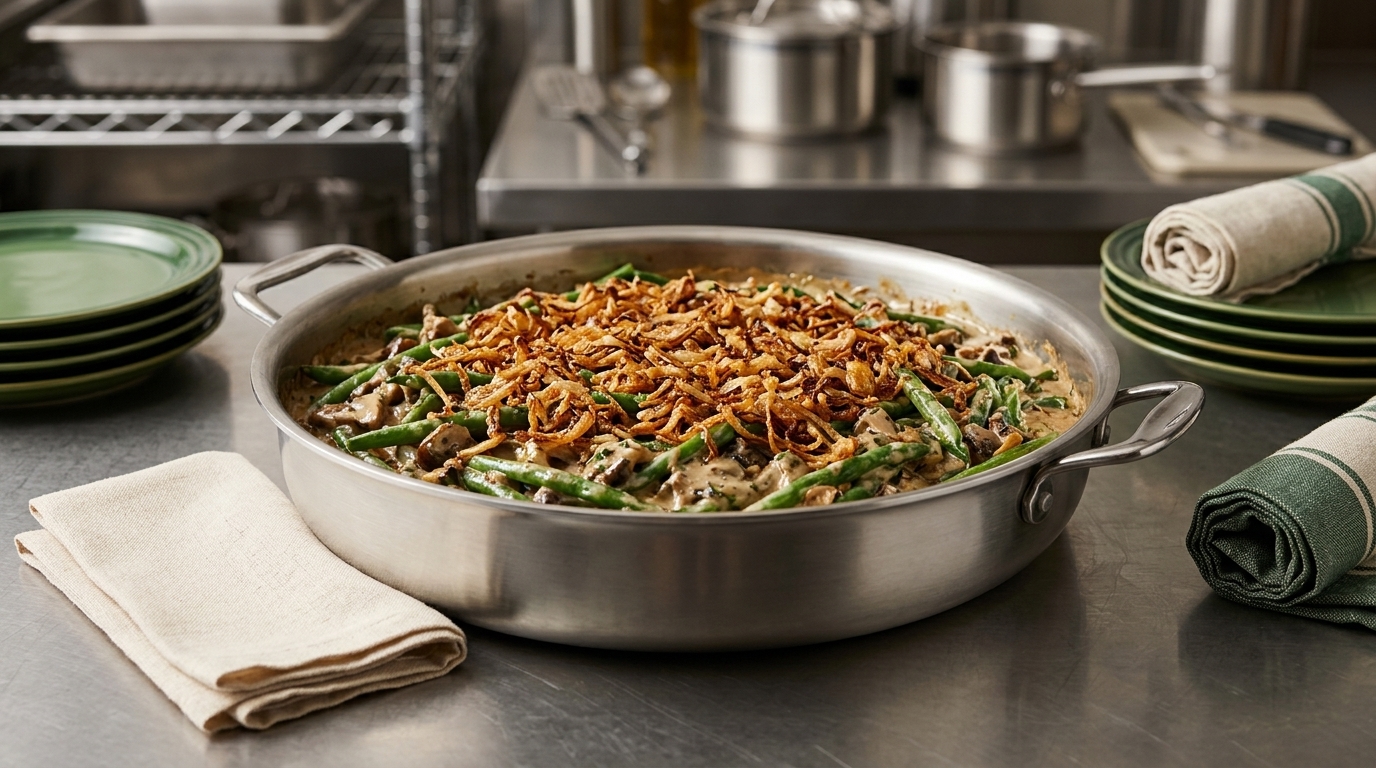
Green bean casserole remains one of the most requested side dishes across November and December corporate holiday parties, community buffets, and family drop off feasts. Yet for commercial kitchens and caterers, the classic comfort staple frequently causes operational frustration. Traditional church social recipes built on canned condensed mushroom soup and canned cut green beans fail quickly under catering conditions. In a chafing dish or heated transport cambro, canned soups release water as starch retrogrades, breaking into an unappealing gray slurry. Overcooked canned beans turn mushy, shedding additional moisture and diluting seasoning. When operators instead approach green bean casserole with commercial culinary engineering, it becomes one of the most profitable, reliable items on the holiday menu.
By replacing canned soup bases with a scratch made mushroom veloute reinforced with blonde roux and heavy cream, culinary teams lock in emulsion stability. By pairing that velvety base with properly blanched fresh beans and packaging crispy fried shallots in dry bags for venue finishing, you eliminate soggy presentation and waterlogged trays. With raw green beans and staple produce commanding modest bulk wholesale prices, an engineered half pan tray delivers gross margins exceeding seventy eight percent. This operational guide provides step by step batch production techniques, thermal holding rules, packaging methods, and cost models to make green bean casserole a showcase of kitchen discipline and margin control.
The Science of Sauce Stability: Why Canned Bases Separate and How Scratch Veloute Wins
The core failure point in catering green bean casserole is sauce breakdown during extended holding. Canned condensed mushroom soup relies heavily on modified cornstarch designed for quick home baking and immediate service. When held above 140 degrees Fahrenheit in a catering chafing dish or insulated transport carrier for ninety minutes, modified starches undergo retrogradation and syneresis. Liquid weeps out from the starch gel matrix, creating a watery pool around the beans while the remaining dairy solids curdle into unpleasant clumps.
To eliminate syneresis and produce a sauce that holds smooth for four hours without weeping, commercial kitchens should build a reinforced mushroom veloute. The formula begins with a sturdy blonde roux made from equal weights of clarified butter and unbleached all purpose flour, cooked gently for four minutes to eliminate raw starch taste without darkening. For bulk batches, incorporate rich roasted vegetable stock or poultry stock, whisking vigorously while simmering until the roux reaches full gelatinization.
Finish the veloute with heavy cream, roasted garlic paste, and finely minced cremini mushrooms that have been hard seared in vegetable oil until completely dry. Searing mushrooms separately drives off their eighty percent internal moisture before they enter the sauce, preventing them from diluting the emulsion later. Season with white pepper, kosher salt, a pinch of freshly grated nutmeg, and a dash of tamari or Worcestershire sauce for umami depth.
When batching sauce ahead of peak holiday rushes, cool the veloute rapidly using an ice paddle or two stage cooling protocols, dropping from 135 degrees Fahrenheit to 70 degrees within two hours, and down to 41 degrees within four additional hours. For operators using Edesia to track batch inventory, logging scratch veloute as a sub recipe ensures accurate stock deduction across all seasonal side dishes while standardizing cost per ounce across multiple kitchen shifts.
Batch Blanching and Shocking Logistics: Locking in Color, Texture, and Cooked Yield
Using raw, fresh green beans is essential for catering success. Canned green beans are already mushy upon opening, and frozen cut beans lose cellular integrity during freezing, discharging large volumes of water as they thaw inside the casserole. Fresh string beans or haricots verts provide snappy tooth resistance, vibrant chlorophyll color, and clean vegetable flavor that balances rich mushroom sauce.
Preparing fifty to two hundred pounds of fresh green beans requires structured batch logistics:
-
Trimming and sizing: Top and tail the beans on large cutting boards using bench scrapers to align stems. Cut standard beans into uniform two inch lengths. Uniform size ensures even heat penetration during blanching and clean portioning with serving spoons on a buffet line.
-
Salting the blanching water: Bring forty gallon steam kettles or large stockpots to a rolling boil. Salt the water generously until it tastes noticeably saline, roughly one quarter cup of kosher salt per gallon. Sodium ions bind with pectin molecules in the bean cell walls, preserving cellular crispness while seasoning the vegetables internally.
-
Timed par cooking: Submerge the trimmed beans into boiling water in five pound wire baskets for exactly two and a half to three minutes. Do not cook them until tender. The goal is par cooking, setting the bright green chlorophyll and softening raw crunch while keeping core fibers firm. The beans will undergo fifteen to twenty minutes of secondary cooking during casserole baking.
-
Thermal shock and draining: Immediately transfer blanched beans into an ice bath containing equal parts water and ice cubes. Plunging them into ice water drops the core temperature below 40 degrees Fahrenheit within sixty seconds, arresting carryover cooking instantly. Once chilled, drain the beans thoroughly in perforated hotel pans for fifteen minutes. Excess water left on the exterior of green beans will dilute your veloute and weaken the casserole structure.
For teams managing multiple Thanksgiving orders, review our operational guide on Thanksgiving catering sides to coordinate kettle boiling schedules alongside potato and root vegetable prep.
Pan Assembly, Par Baking, and Thermal Management for Drop Off and Buffet Lines
Assembly and thermal execution dictate whether your casserole arrives at an office luncheon bubbling and appetizing or dry and scorched. Commercial catering kitchens should standardize on two inch deep stainless steel or heavy gauge aluminum half pans. Deep four inch pans trap too much steam in the center, causing the middle beans to overcook into mush while the outer edges dry out.
Standard assembly per half pan follows strict weight standards:
- Green beans: Three pounds of drained, blanched green beans.
- Mushroom veloute: Two and a half pounds of velvety scratch sauce.
- Folding: Gently fold the beans and sauce together in a large stainless bowl until every bean is evenly coated, then spread into the half pan in an even layer.
- Interior topping: Fold two ounces of grated aged parmesan or white cheddar into the top layer to create a savory crust that shields the beans during initial bake.
Par baking protocol: Bake assembled pans uncovered in a convection oven preheated to 350 degrees Fahrenheit with low fan speed for eighteen to twenty minutes, until the center reaches an internal temperature of 145 degrees Fahrenheit and bubbles gently around the perimeter.
Holding and transport: If servicing drop off catering orders, cover the pans securely with parchment paper and crimped heavy duty aluminum foil. Place pans into preheated insulated food carriers. Properly preheated carriers maintain food above 150 degrees Fahrenheit for up to four hours without external electrical heat.
For banquet buffets, consult our comprehensive buffet set up guide to implement shallow pan rotation. Instead of placing a deep full pan on the chafing dish line where it sits for two hours, rotate half pans every thirty minutes. Shallow pan rotation ensures every guest receives piping hot beans with glistening sauce rather than dried out edges.
Packaging Crispy Shallots, Menu Pricing, and Half Pan Profit Margins
The hallmark of classic green bean casserole is the crunchy onion topping. Yet nothing ruins a catering delivery faster than scattering fried onions over the casserole before crimping foil on top. Steam rising from hot sauce condenses against the foil lid and drips back down, turning crispy toppings into a soggy, greasy layer within twenty minutes.
Professional catering kitchens solve this with separate topping kits:
- Scratch shallot crisps or bulk French fried onions: Portion six ounces of fried shallots or French fried onions into clear poly zip bags or paper deli bags per half pan tray.
- Labeling and service instructions: Staple a laminated instruction card to the pan lid: Keep topping bag separate at room temperature. Remove foil lid, scatter crispy shallots evenly across casserole surface five minutes before serving to preserve maximum crunch.
- Attendant plating: For full service banquets, catering captains keep topping pans on the back staging table, adding fresh crispy shallots only as each new pan hits the buffet line.
Now examine the unit economics of a standard catering half pan that serves twelve to fifteen guests:
- Fresh green beans (3.5 pounds trimmed yield from 4 pounds raw at $1.80 per pound): $7.20
- Scratch mushroom veloute ingredients (cremini mushrooms, stock, butter, flour, cream, seasonings): $3.80
- Crispy fried shallots or onion topping (6 ounces): $1.90
- Aluminum half pan, dome lid, parchment, and labeling: $1.40
- Total prime food and packaging cost per half pan: $14.30
Commercial caterers routinely sell holiday vegetable side trays for $68.00 to $78.00 per half pan. At a retail menu price of $72.00, your direct cost percentage sits at 19.9 percent, leaving an exceptional gross margin of 80.1 percent, or $57.70 in gross profit per pan. To calculate your exact food cost percentage across different batch volumes and local wholesale distributor quotes, explore our guide on how to calculate food cost percentage.
Tracking trim waste on bulk green bean cases is equally critical during busy holiday production. Use our daily restaurant waste log to monitor prep efficiency and prevent excessive stem trimming from eroding your ingredient margins.
Frequently asked questions
Can green bean casserole be prepped and assembled forty eight hours in advance?
Yes. Commercial kitchens can blanch green beans, prepare scratch mushroom veloute, and assemble covered pans up to forty eight hours before event service. Store assembled pans in the walk in cooler below 38 degrees Fahrenheit. When ready to cook, bake directly from chilled staging, adding ten to twelve minutes to standard oven bake times until core temperature hits 165 degrees Fahrenheit. Always keep crispy onion toppings separate at room temperature until the final five minutes of baking or service.
How do commercial caterers keep fried shallots crispy during transport?
Never cover hot casserole pans with crispy shallots already applied. Steam trapped beneath foil lids quickly saturates fried toppings with moisture. Package fried shallots or onions in separate dry poly bags or bakery boxes. Instruct drop off clients or on site banquet staff to scatter the topping over the hot casserole immediately before guests arrive at the buffet.
What is the optimal hot holding temperature for green bean casserole?
Maintain green bean casserole between 145 and 155 degrees Fahrenheit in chafing dishes or holding cabinets. Holding below 140 degrees risks food safety violations, while holding above 165 degrees for extended periods scorches bottom sauce layers and causes overcooked beans to soften excessively. Use shallow water pans and stir gently every twenty minutes during buffet service.
What is the ideal profit margin on commercial holiday side trays?
Catering side dishes like green bean casserole should target food cost percentages between 18 and 22 percent, generating gross profit margins near 80 percent. Because vegetable staples carry lower cost per pound than banquet proteins like prime rib or roast turkey, high margin side trays subsidize overall event food cost and boost net catering profitability.
Conclusion
Engineering your holiday sides with the same operational rigor as center of the plate proteins elevates your brand, protects guest satisfaction, and drives outstanding kitchen margins. By ditching canned soups in favor of a stable scratch veloute, executing precise blanch and shock protocols, and safeguarding crispy textures with separate topping packaging, your kitchen turns green bean casserole into a dependable revenue driver.
To streamline ingredient purchasing, automate supplier shopping lists, and track recipe costing across all your holiday catering packages, see how Edesia helps commercial kitchens eliminate admin, reduce food waste, and run more profitable operations every season.
Try it on your own menu
Use the menu item contribution calculator to run your numbers in your browser. No signup required, and your data stays on your device.