Phyllo Cup Appetizers for Commercial Catering: Shell Crispness Systems, High Speed Batch Piping, and Holiday Margin Controls
Learn how commercial catering kitchens engineer high margin phyllo cup appetizers. Master shell crispness controls, rapid piping line prep, and safe ambient holding.
Photo by Jonathan Borba on Unsplash.
Holiday cocktail parties and corporate receptions place intense pressure on commercial catering kitchens. Event planners demand intricate, elegant passed hors d'oeuvres that feel bespoke, while kitchen operators must protect tight prep schedules and defend bottom line profitability. Phyllo cup appetizers have emerged as one of the most reliable vehicles for high margin holiday catering. These miniature pastry shells offer striking visual elegance, delicate shatter crisp texture, and natural portion control. However, scaling phyllo appetizers across events of three hundred or five hundred guests presents distinct operational challenges. Without precise moisture barriers, the thinnest pastry layers absorb moisture rapidly and turn limp on the buffet line. Without structured assembly line workflows, piping hundreds of miniature cups eats up valuable prep hours. This commercial kitchen guide breaks down the operational systems required to execute flawless phyllo cup appetizers at volume, from shell sourcing and moisture chemistry to high speed piping routines and plate cost economics.
The Operational Economics of Sourced Shells Versus Scratch Production
The first decision every caterer faces is whether to produce phyllo cups from scratch using sheets of raw dough or to purchase commercial prebaked shells. Producing shells in house involves brushing multiple sheets of raw phyllo with clarified butter, cutting them into two inch squares, pressing staggered layers into mini muffin tins, and baking them until golden. While raw ingredient costs for in house production average roughly eleven cents per dozen, the labor requirement averages three and a half minutes per dozen for brushing, cutting, pressing, and unmolding. At a kitchen wage of twenty two dollars per hour, labor adds over ten cents per shell. In contrast, commercial prebaked mini phyllo shells cost between twenty two and twenty eight cents per unit wholesale when ordered in master case quantities of four hundred eighty pieces. Commercial shells arrive uniformly formed, perfectly crisp, and packed in rigid plastic blister trays that prevent breakage during storage. For catering runs exceeding one hundred fifty pieces during peak holiday volume, purchasing commercial shells saves critical labor hours while eliminating inconsistent cup depth and pastry breakage. For related bakery batch workflows, review our guide on puff pastry appetizers.
Moisture Barrier Chemistry and Crispness Defense
Phyllo pastry consists of paper thin sheets of unleavened flour dough separated by microscopic layers of fat. When exposed to liquid water from a filling, the delicate starch structure hydrates instantly, dissolving the crisp lamination into a soggy paste. Defending crispness requires understanding moisture barriers. Commercial kitchens must implement a two part barrier protocol before adding wet fillings. First, unbox the prebaked shells and arrange them on sheet pans lined with parchment paper. Lightly mist or brush the interior of each cup with a thin film of clarified butter or warm extra virgin olive oil. The fat coats the internal pastry wall, creating a hydrophobic seal that repels water molecules. Second, run the sheet pans through a convection oven at three hundred fifty degrees Fahrenheit for four to five minutes with low fan speed. This quick bake drives off ambient atmospheric humidity absorbed during storage and sets the fat barrier firmly into the pastry ridges. Let the shells cool completely to room temperature on open wire racks before introducing any filling. Placing cold or warm filling into a warm shell creates trapped condensation that destroys crispness from within. For related texture preservation strategies, inspect our analysis of crostini appetizers.
Formulating Low Moisture Savory Fillings
Even with an optimal fat barrier, fillings with high free water content will compromise shell integrity over a multi hour cocktail reception. Commercial caterers should formulate fillings with high solids content, emulsified fats, and bound starches rather than watery purees. Whipped cheese bases provide the ideal functional matrix. Combining fresh goat cheese with mascarpone or block cream cheese in a food processor produces a velvety, pipeable base with less than fifty percent free moisture. When formulating savory vegetable fillings such as mushroom duxelles or caramelized onions, cook the vegetables down until all surface steam ceases and the mixture releases clean fat in the pan. Deglaze with fortified wine, reduce to a dry paste, and fold the mixture into chilled ricotta that has drained overnight in cheesecloth. For fruit compotes such as spiced cranberry or fig preserves, thicken the sauce with pectin or modified food starch until it registers forty five to fifty degrees Brix. A dense compote sits atop the cheese foundation as an accent rather than migrating into the pastry wall. Master portion weights and menu math with our guide on how to calculate food cost percentage.
High Speed Batch Piping Stations and Assembly Line Mise En Place
Assembling hundreds of delicate bite size appetizers requires structured kitchen ergonomics. Placing filling into cups with spoons is unacceptably slow, produces messy rims, and leads to inconsistent portion sizes that inflate food cost. Commercial kitchens should deploy an assembly line piping station manned by two cooks. Cook one arranges crisped shells in neat grid patterns of sixty pieces per full sheet pan. Cook two uses an eighteen inch heavy duty disposable pastry bag fitted with an open star or round tip. Filling bags half full maintains hand control and prevents forearm fatigue during long runs. Working systematically across the grid, cook two pipes a single zero point seven five ounce rosette into each cup in under one second. Cook one immediately follows with garnishes, using culinary tweezers or small portion spoons to deposit microgreens, toasted crushed pistachios, or pomegranate arils. A two person team can easily pipe and garnish four hundred pieces in under twenty five minutes. If the event calls for a warm service, load sheet pans onto rolling speed racks and flash bake them in a three hundred seventy five degree oven for three minutes immediately before loading onto service trays. For ambient service, transfer sheet pans directly into speed racks in a cool holding zone until tray transfer. Review high volume station setups in our buffet setup guide.
Four High Margin Holiday Menu Formulations
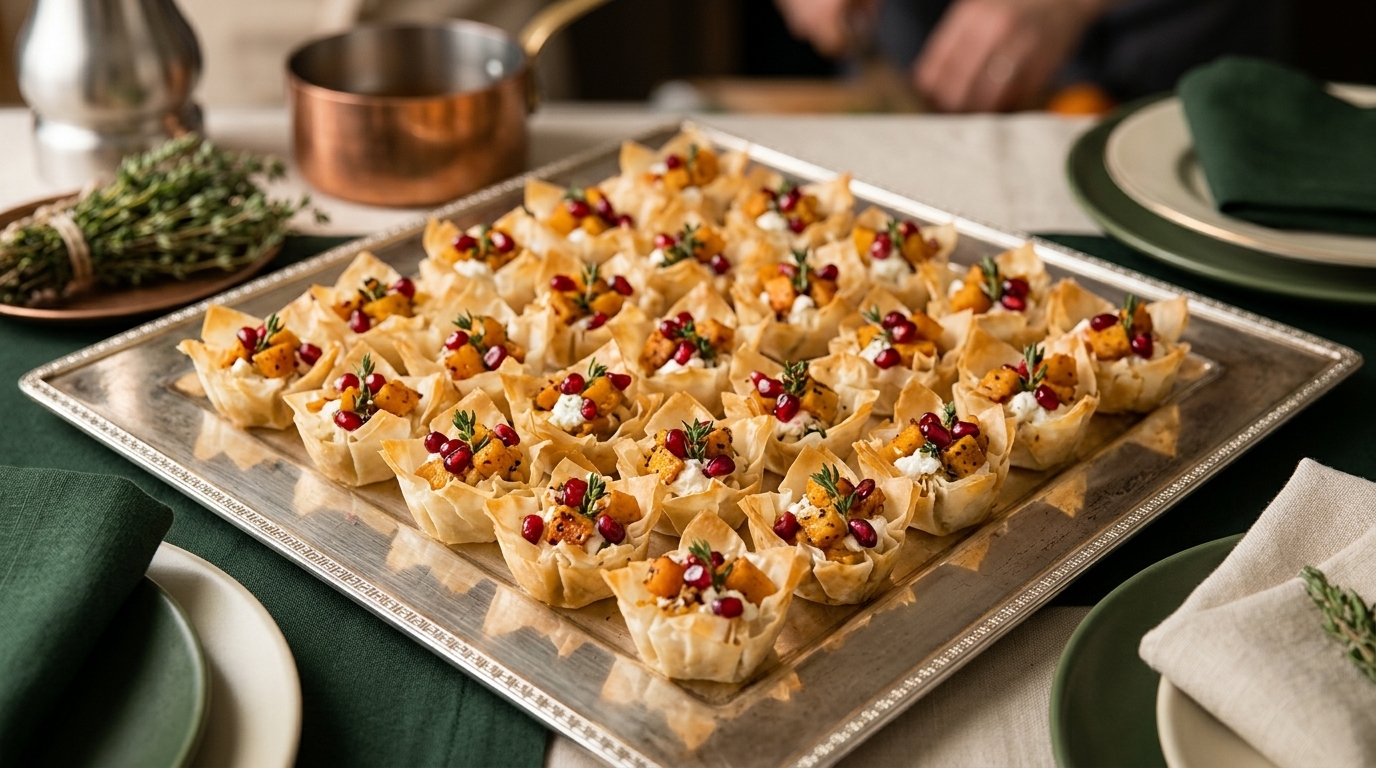
To build a profitable holiday catering menu, offer three distinct phyllo cup formulations that cross utilize core pantry items while catering to diverse guest preferences. First, Whipped Goat Cheese with Spiced Butternut Squash and Hot Honey. This combination pairs whipped chevre with roasted squash cubes, a drop of hot honey, and fresh thyme. Shell cost is twenty four cents, filling cost is eighteen cents, and garnish is four cents, bringing total plate cost to forty six cents. Priced at two dollars and twenty five cents per passed piece, this item delivers a seventy nine point five percent gross margin. Second, Wild Mushroom Duxelles with Gruyere and Crisped Leeks. Finely minced cremini and shiitake mushrooms cooked down with shallots, thyme, and heavy cream, topped with shredded cave aged gruyere. Total unit cost is fifty two cents against a menu price of two dollars and fifty cents, yielding a seventy nine point two percent margin. Third, Spiced Cranberry, Brie, and Candied Pecan. Diced double cream brie layered with scratch orange cranberry jam and crushed glazed pecans. Unit cost is forty eight cents against a price of two dollars and twenty five cents, generating a seventy eight point seven percent margin. Fourth, Chilled Smoked Salmon Mousse with Pickled Shallot and Fresh Dill. Cream cheese and hot smoked salmon puree piped cold and crowned with quick pickled red shallot and baby dill. Unit cost is sixty two cents against a menu price of two dollars and seventy five cents, delivering a seventy seven point five percent margin. Find broader holiday menu pairing strategies in our holiday appetizers guide.
Packaging, Transport, and On Site Holding Logistics
Transporting delicate pastry cups to remote banquet halls or private residences requires specialized packaging protocols. Never pack filled phyllo cups loosely in hotel pans or disposable foil containers where vibration will crack fragile edges. Utilize commercial pastry box inserts with individual round cavities, or line full sheet pans with textured silicone baking mats that prevent lateral movement during vehicle transit. When loading sheet pans into mobile transport carts or insulated carriers, maintain a strictly ambient temperature zone between fifty five and sixty five degrees Fahrenheit for cold or ambient items. Never cover warm filled cups with cling wrap or foil. Trapped steam will condense on the underside of the cover and rain down onto the pastry, destroying hours of crispness prep within fifteen minutes. If transporting warm hors d'oeuvres, transport the crisped shells in dry ambient boxes and pack fillings in preloaded pastry bags held in insulated cambros at safe holding temperatures above one hundred thirty five degrees Fahrenheit. Your on site banquet team can then pipe fresh, hot filling directly into crisp shells two minutes before the service trays hit the cocktail floor. For off premises event systems, consult our guide on catering run of show.
Frequently asked questions
How should commercial kitchens store bulk prebaked phyllo shells before filling?
Store prebaked phyllo shells at room temperature in their original blister packs inside dry storage. Do not refrigerate or freeze raw shells because moisture and condensation weaken the pastry layers and cause immediate sogginess upon thawing.
How far in advance can caterers fill phyllo cups without losing crispness?
When pretreated with an oil or clarified butter barrier pass and filled with low moisture savory bases like stabilized whipped cheese or duxelles, filled shells hold their crisp bite for three to four hours at controlled ambient room temperature.
Can filled phyllo cup appetizers be reheated on site without becoming soft?
Keep the hot filling below seventy percent water content and flash heat filled trays at three hundred seventy five degrees Fahrenheit for three to five minutes right before service. Avoid covering warm trays with plastic wrap or foil to prevent steam traps.
Conclusion
Building a high volume hors d'oeuvres program does not require sacrificing pastry texture or overwhelming your kitchen team during peak holiday weeks. By standardizing on commercial prebaked shells, establishing strict fat barrier defenses against moisture, and deploying high speed piping stations, your kitchen can produce hundreds of elegant bites per hour while defending gross margins above seventy five percent. The key to consistency is disciplined ingredient planning and real time purchasing control. Edesia helps commercial kitchens and catering teams track inventory across multiple event menus, automate supplier orders, and monitor plate costs down to the penny. Explore how Edesia simplifies catering production and keeps your holiday operations profitable.
Try it on your own menu
Use the menu item contribution calculator to run your numbers in your browser. No signup required, and your data stays on your device.